
Time governs every aspect of modern civilization, from financial transactions to satellite navigation systems. At the heart of global timekeeping lies one of humanity’s most precise inventions: the atomic clock. Understanding how do atomic clocks work reveals the fascinating science behind the technology that keeps our interconnected world synchronized and functioning seamlessly.
The Basic Principle Behind Atomic Timekeeping
Unlike traditional clocks that depend upon the moving mechanical components or quartz crystals, atomic clocks utilize the natural vibration of atoms to provide extreme accuracy in measuring time. These remarkable instruments rely on the fixed frequency of electron transitions for a certain energy level inside the atom. This frequency is unchangeable, which thus provides the most stable basis for accurate timekeeping.
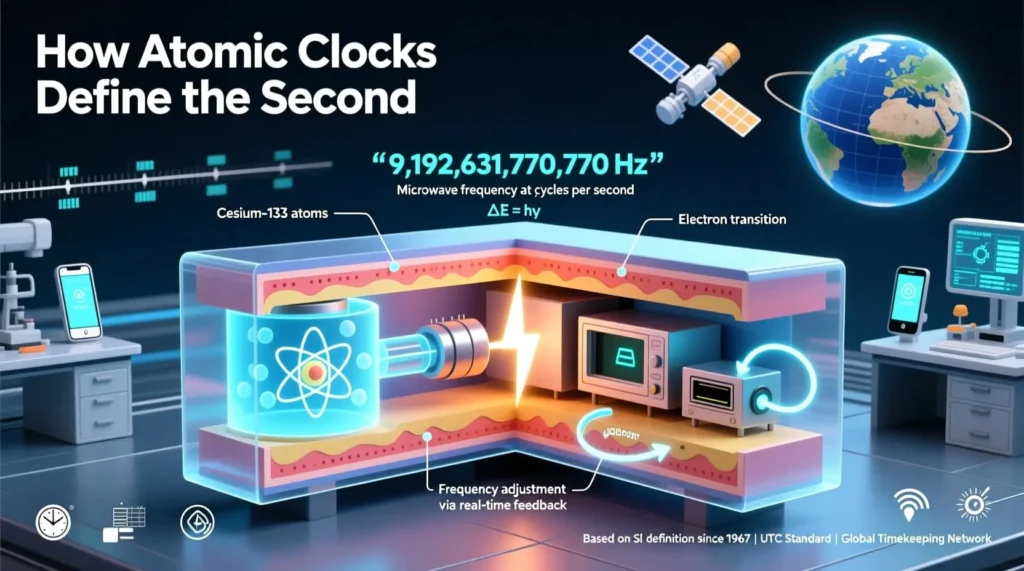
Almost always, cesium-133 atomic clocks are the most common. Scientists discovered that cesium atoms vibrate with great regularity when going from one of two specific energy states: indeed, all of them do that at precisely 9,192,631,770 cycles per second. This unwavering consistency was thus adopted as the international standard for the definition of one second in 1967.
How Do Atomic Clocks Work in Practice?
The principal reason for having a cesium atomic clock is to begin with the process of heating cesium metal to give a vapor of cesium atoms, which will thereafter pass through a magnetic field, which allows for separation of the cesium atoms according to the energy states. Only those atoms that remain in a defined energy state will proceed further through the setup.
Next, these selected atoms will enter a microwave chamber and collide with microwave radiation of a precisely set frequency. Exactly when the microwave frequency matches the cesium atoms’ natural resonance, the electrons will jump to a higher energy level. A detector is used to measure how many of the atoms underwent this transition.
The electronic part of the clock will then continuously adjust the microwave frequency to maximize the number of atoms undergoing the profitable transition. This feedback loop ensures that the oscillator locks onto the natural atomic frequency, yielding a very stable and accurate reference of time.
Different Types of Atomic Clocks and Their Applications
In addition to cesium types, a lot of other kinds have been developed by scientists for various applications. Rubidium atomic clocks are somewhat smaller and cheaper to build, but they rank lower in accuracy than cesium ones. These small rubidium atomic clocks find their way into telecommunications devices and GPS satellites.
Hydrogen maser clocks are useful for radio astronomy and deep-space communication due to their very high short-term stability. However, the longer-term drift of these clocks is compensated by an immediate precision that becomes critical for certain scientific endeavors.
Its latest generation includes optical atomic clocks employing strontium or ytterbium atoms. This highly advanced technology measures frequencies in the visible light spectrum as opposed to microwaves, with accuracy high enough to neither gain nor lose a second in billions of years.
The Role in Establishing Coordinated Universal Time
Contributors toward the calculation of Coordinated Universal Time (UTC) comprise about 450 atomic clocks located in laboratories in over 80 countries. Data from these clocks are collected by the International Bureau of Weights and Measures in France, which calculates a weighted average.
This system of collaboration prevents any single failure of a clock from affecting timekeeping for the entire globe. There is a system in place for redundancy, while deviations exhibited by individual clocks are reduced by averaging, providing at least a reasonably accurate time standard.
UTC is the basis for time zones across the globe. The ultimate calculations for every smartphone, computer, and network server make their way to atomic clock measurements, which were disseminated by various synchronization systems.
Practical Applications in Everyday Life
GPS navigation is atomic clock accuracy. Each satellite carries several atomic clocks measuring time and sending the signal down to the Earth. Your GPS receiver computes where you are by calculating incredibly tiny differences in the signal arrival time from several satellites. Without atomic clock accuracy, GPS would be worthless minutes later.
The financial markets timestamp transactions using synchronized atomic time. High-frequency trading systems need microsecond accuracy to operate. Timed to the atomic clock, telecommunication networks synchronize data transmission across continents.
Scientific research, from particle physics to the detection of gravitational waves, requires atomic clock accuracy. These applications are putting pressure on scientists to realize even more accurate clocks and, in the process, promoting basic science and its practical technologies.
The Future of Atomic Timekeeping
Research is still advancing the limits of accuracy. The optical lattice clocks, with more precision, are now approaching the values that put our current understanding of the second to the test. The second may be reset based on the optical frequency in a decade-long discussion.
The portable atomic clocks are becoming smaller and cheaper, making it possible to enter new realms of application in the autonomous car, secure communications, and precision agriculture. The evolution of quantum computing may eventually generate even more radical technologies in timekeeping.
The pursuit of perfect time measurement stimulates growth across disciplines of science. Each step forward in atomic clock technology creates new potential, whether for navigation, communication, or fundamental physics research.
Conclusion
The science explaining how do atomic clocks work demonstrates humanity’s remarkable ability to harness natural phenomena for practical purposes. By measuring the unchanging vibrations of atoms, these extraordinary devices provide the timing foundation our modern world requires. From GPS navigation to international finance, atomic clocks invisibly support countless systems we depend upon daily, ensuring our globally connected civilization runs precisely on time.